


SlackLine set
TravelLine Set
The TravelLine corresponds to the DIN guidelines for slacklining (German industry norm 79400) and is TÜV approved.
- 20 Kn Breaking Load
Will it work where I am? Answer 3 quick questions
Here’s what to consider for your setup:
Your setup looks suitable for this SlackLine set. Check the product specifications and follow the included setup guide.
Why TravelLine Set

Travel ready
Weighs under 2 kg and fits easily into any backpack.

Use it anywhere
Take the TravelLine Set to the park, the beach, the mountains or the city.

Quick setup
Attach between two trees or anchor points for fast installation.


Plan your space
Will it work? Here’s what you need
Set up between two healthy trees, using tree protection on both trunks. Check your set’s specified length before choosing your spot.
Plan your setup
|
Setup |
Good for |
|---|---|
|
Shorter, lower line |
Learning and first steps |
|
Longer line |
Progressing within your set’s specifications |
Tree spacing and maximum line length vary by set. See this product’s specifications below and follow its supplied setup guide.
Where it works
- ✓Parks
- ✓Backyards with healthy trees
- ✓Campsites
- ✕No trees or suitable anchors
- ✕Thin or weak trees
Setup
Set up your SlackLine
Follow the setup guide supplied with your product.
- 1
Protect both trees
Use tree protection around both trunks to protect the bark and your webbing.
- 2
Loop the line
Wrap the line around the first tree as shown in the guide supplied with your set.
- 3
Attach the tensioning system
Follow your set’s guide to attach the ratchet strap or straps.
- 4
Tension and check
Follow the supplied guide to tension the line and check all locks and protection before stepping on.
Your balance journey
Your balance journey
Most people start on a SlackBoard, step up to a SlackYard or SlackRack, then take a SlackLine anywhere.
- 1 ·
Start
Start: SlackBoard
Build balance at home, a few minutes a day.
- 2 ·
Progress
Progress: SlackYard or SlackRack
Walk a real line, low and steady: outdoors or indoors.
-
You are here3 ·
Go anywhere
Go anywhere: SlackLine
Take it between two trees, from parks to trips.
Compare
Which slackline setup is right for you?
| Feature |
SlackLine |
SlackYard |
SlackRack |
|---|---|---|---|
|
Anchors |
Two strong trees |
Ground screws |
None |
|
Where it works |
Anywhere with trees |
Grass and soil |
Any flat surface |
|
Line length |
Varies by set |
3–16 ft |
7 ft or 10 ft |
|
Height off ground |
Depends |
10–16 in |
~1 ft |
|
Setup |
10–15 mins |
10–15 mins |
15–30 mins |
|
Best for |
Outdoors |
Backyards |
Indoors |
Details
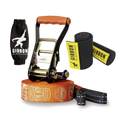
The TravelLine corresponds to the DIN guidelines for slacklining (German industry norm 79400) and is TÜV approved. Includes ratchet protection (RatPad) and TreeWear which protects the trees for more environmental sustainability and saves your slackline from damage!
- 20 KnBreaking Load
Specifications
- Specifications
- GIBBON Slacklines TravelLine with treewear, brown, 15m (12,5m line + 2,5m ratchet strap with reinforced loop), for beginners and advanced slackliners, ideal for traveling and to take on vacations, incl. ratchet protection and ratchet with safety lock, 50mm/2" wide, tree and line protection (black felt with velcro), perfect leisure activity
- Specifications
- 12,5m Slackline with reinforced loop, ratchet with safety lock and 2,5m ratchet strap with reinforced loop, setup guide, 15m complete set (12,5m line + 2,5m ratchet strap), width 50mm/2", 2x treewear (black felt with velcro)
- Specifications
- Simple and fast setup between trees or similar solid anchor points
- Specifications
- Flat webbing, especially developed for slacklining (trampoline effect). Continuous print for better grip and orientation on the line. The ratchet's ergonomically optimized plastic handle allows a comfortable and efficient tensioning.
- Breaking Load
- 20 Kn
Frequently asked questions
Can I set up a slackline without trees?
Yes. The SlackYard is a freestanding option for grass or compact soil and lets you start just a few inches off the ground. The SlackRack is a portable freestanding frame you can use indoors or outside.
Do I need tree protection?
It's always recommended. GIBBON Treewear protects both the tree and your webbing from abrasion.
How do I start slacklining?
Start by standing on one foot. Keep your back straight, your arms up, your knee softly bent, and breathe deeply. Once you can stand comfortably on each leg, start taking your first steps. Your leg will shake a lot at first, and that’s normal. With practice, it settles down.
How high should I set it up?
Below the user's hip height, but high enough that the line doesn't touch the ground when someone is standing or walking on it. If you're just starting out, keep it low.
How long should my slackline be?
You can set up your slackline up to the maximum length listed on the product page, minus the distance around both trees. A shorter line is easier when you’re starting out.
How tight should the line be?
For most beginners, don't exceed 100 lbs of tension. Usually you only need enough tension that the line vibrates when you flick it with your finger.
Is slacklining dangerous?
Like any sport, slacklining has some risk. Start within your ability, with the line short and low to the ground. As you progress, you can lengthen the line and raise it for more challenge.
Should I slackline barefoot or with shoes?
It’s personal preference. If you wear shoes, choose a flat rubber sole. Never slackline in heels or shoes with a lugged sole.
What's the minimum age?
Slacklining is suitable for all ages. We recommend that children under 12 use slacklines only with support and supervision.
What's the weight limit?
Our slacklines are rated between 3,000 and 6,000 lbs depending on the model. For safe use, we recommend one person at a time and a maximum user weight of 250 lbs.
Which slackline is best for beginners?
Start with a 2" line like the ClassicLine series or the TravelLine. These lines stretch less, allowing lower, more stable setups, and the printed webbing adds grip for those first steps.
Which slackline should I choose?
Our slacklines vary in length, width, and design, but the biggest difference is how much the line stretches. If you want to do tricks and jumps, choose a more dynamic line like the JibLine or SurferLine.